
I Won’t Do It
A play and interactive art installation in the spirit of eco-feminism. Directed by Namrata Bhutoria, made by the ColorAshram team with many artists and curators.
30 November 2025 · Jagannatha Centre for Art and Culture (JCAC), Mysuru ↗

She likes to giveHe likes to takeThis is how the relationship is bornShe likes to giveHe likes to takeDay after day — the cycle continuesThe demand grows, the silence deepensShe likes to giveHe likes to takeA day comes and he asks her to give upAnd she says.. I won’t do it
What if ‘She’ is the Earth, and ‘He’ is the Human? An experiment with truth, at an intersection of war, political and social ideology, and ecology.

Why we made it
Why a play
Because we love the power of art, music and performance to create the blank canvas on which the audience can paint. We need a new system, one that rewards compassion, a shift in mindset and well-being. The play is our attempt to tell a balanced story of a time of war, ideology, patriarchy and craziness that resonates deeply with the time we live in today.
Why ColorAshram
ColorAshram works for ecology and humanity through natural dye training and services. We find ourselves at the intersection of patriarchy, capitalism, colonialism, consumerism, religious dogma, political insanity and never-ending wars. This play was an attempt to intrigue people into engaging with the difficult task of shifting mindsets: to build a safe society and safe systems, not just a safe home for ourselves and the generations to come.
The story
Based on Valentin Rasputin’s Russian novel Live and Remember (1974), set in Siberia during the Second World War. A young married soldier deserts the Red Army because he longs to return to his wife. A deserter must hide, because the army will put him in front of a firing squad.


Is it history we’re watching, or the present?
Welcome to “I Won’t Do It.” This is not just a play: it’s an invitation to pause, to reflect and to listen to your inner voice, free from the everyday race and mundane tasks.
The audience walked through the art installations, absorbing the visuals, sound and emotion that filled the space. Then came a powerful musical performance, and the evening ended with a short video anthology.
This play is not an attempt to change society, but to challenge the narratives we’ve taken for granted, and to truly feel the forces that shape our lives.
In the play, we travel to a remote Siberian village where a couple, Andrei and Nastena, live a quiet life until Joseph Stalin’s Red Army calls all men to fight in the Second World War. Their ordinary world collapses into fear, intimacy and conflict.
Behind the curtain is a backdrop of power and propaganda. After centuries under the Tsars, the 1917 Bolshevik Revolution promised freedom, and truly so: it had been a terrible time for humanity, people treated as slaves under the banner of loyalty to the king and the church. In the name of Marxism, the revolution brought freedom disguised as yet another dictatorship, first under Lenin, and then, far worse, under Stalin.
Stalin mastered the art of propaganda, turning theatre itself into a weapon of persuasion. He once said, “The death of one man is a tragedy; the death of a million is a statistic.” Millions were exiled into the Siberian wilderness. Lands were seized in the name of collective farming and mechanised agriculture. The experiment failed, and famine spread across the Soviet Union. And yet, when war came again, even those far away in Siberia, people who had nothing to do with Moscow’s politics, were forced to fight.
This is where our play begins. Andrei, a peasant forced to fight, is injured and escapes into the Siberian forest. His wife, Nastena, is caught in the storm of being a deserter’s wife: torn between her husband’s fear of being caught by the ruthless Red Army, the villagers who would never accept a deserter’s child, and the militia who would never forgive a man who refused to fight. Driven by this unbearable tension, the real Nastena in Rasputin’s story ends her life.
In our play, we chose to imagine a different ending: the freedom to choose. What if a single “No” could transform a mindset fixed by culture and society? The power of one refusal, one act of courage, might still echo in our times.

Namrata Bhutoria
The meaning of “I won’t do it”
“I Won’t Do It” is not a negative or disruptive statement, as many use it for a frivolous understanding of freedom. It’s a deep response out of self-respect, dignity and the true destiny of a human being. We hope one does not misinterpret, misunderstand or abuse it. We sincerely empathise with the hurt and abused, and agree to their right to be angry, and yet recognise that action must not be about dehumanising. Our character Nastena does not say I won’t do it with anger or vengeance, rather with deep breathing of her strength to live rather than die for honour or fear. With freedom comes responsibility.
A disclaimer for the assuming
Don’t imitate or role copy any of our characters from the story. We would like you to watch the play, or read about it or follow it with your own discretion and wisdom. Here is a fact: this is not your story, even if it looks like yours. Your story and your call are unique to your chemistry and environment. You can watch it and be inspired, but in reality, can you or any of us know or understand Nastena? This production is an attempt to present a story by adapting what we understood as a collective of people. We were part of several conversations over the last two years. And the final synthesis was mine.
Why eco-feminism
It all began for me when I discovered that ecology sensitivity begins with respecting feminine energy in both women and men, and it automatically transcends to the Earth and other life forms. It’s the logical and intelligent respect of nurturing nature. And we are nature. At ColorAshram, we follow the system of living in one box, following what we truly understand. It begins with respect for everything that nurtures and is held in balance by all forces of Nature, except humans.
On stage

Photographing this play was a deeply immersive experience. I was mesmerised by the magic of the light, the earthy tones of the scenography, and the depth of the actors’ performances. Each element worked in quiet harmony, creating moments of intense presence that felt both fleeting and timeless.


What people said
Before the play
“Mysuru has not witnessed such an endeavour, although Mysuru has a deep tradition of respect for art and culture. This event is an evolution and revolution of what is contemporary and yet so old.”
Ruchika Naidu“You have always been the one to look within, to question what is obvious, to relentlessly search, to try to listen to the universe and talk to your soul… Your restlessness to not settle for what society attempts to decide for us, to question conventional norms that bind us rather than setting us free… I salute you, my darling, for being the woman to set an example to refuse a life of half-truths. Your endeavours to continuously work for the saving of the environment are commendable.”
“Nothing Namrata does is conventional. I am waiting to witness the full adventure she has embarked on. Her manifesto is the best thing I’ve read about building not just a team for a performance but a healthy community for all, through our commitment. Bravo all.”
Kamakshi“We are very happy to learn about your production and very impressed… Your idea of crowdfunding is also good. We would like to contribute Rs 2000 towards production… I am sure it is going to be a memorable event. You have our best wishes.”
Ravi Kumar, the WaterMan“Watching your journey has been nothing short of inspiring. You’ve risen through self-belief, resilience, and relentless effort, and now you’re not just standing tall, you’re lifting others with you… The world needs more people like you.”
Shiree Arora“Wishing the best for the play, Namrata. Mysore needs you and I’m so glad you all are coming together and doing something like this. Wishing you guys love and luck, loving everything I’m seeing on Instagram.”
Harshvardhan RaiAfter the play
“Congratulations for your efforts to produce something so much out of the ordinary. It was very impressive.”
Anil Kumar, KalpaShetra Foundation“What a stunning performance last night. I think you took Mysore by storm.”
Mohan“This experience felt like a blessing. If I was able to find comfort on that stage, if I was able to connect with the audience and convince them through my acting, it was entirely because of you, the incredible backstage team… As our beloved director always says, this was not just a play, but an experience. I truly believe this story will extend beyond the theatre walls, giving courage to those who need to say ‘No’ to difficult but necessary situations in their own lives.”
“Our play was stunning. Our director has raised the bar for expressive yet minimalist performance, certainly in Mysuru.”
Kamakshi“It was a powerful play… subdued acting… excellent musical score, very sombre and ominous, artfully done settings with minimalist presence… on the whole a scary reminder of what could happen in an authoritarian regime. Every generation needs to be reminded of it.”
Ravi Joshi“The movement, the music and the context of this scene has always touched my heart and soul… We all want to say NO to many things and we can, then what is stopping us? Just take that step forward and breathe and be free.”
Ruchika Naidu“Huge congrats to Namrata Bhutoria and team for their gorgeous theatre production last night! So lyrical and poetically rebellious. Loved the natural dye and handmade set designs from ColorAshram!”
Sandi Higgins“Was a truly unique experience. Loved the play, the sets, the direction, the ambience. Look forward to the next play.”
Kusum Aggarwal“Thank you! The young people really brought the story to life… and with what intensity!”
Dr Latha Muthanna“Every moment of it, and I can’t wait to share the gallery. What a treat!”
Sonia Frydrych, our volunteer photographer“Congrats, it was a moment of poignancy. A great milestone for Mysore. It is changing the face of theatre in Mysore.”
Shohaib“Thank you so so much for giving me this opportunity. I feel like I’ve learned a lot, and had so much fun in the process. Truly the best play I’ve worked on.”
AnupamaThe team
 HariLead actor
 Rajalakshmi K MurthyLead actor
 Namrata BhutoriaDirector
 SouhardaNarrator
 KamakshiStoryteller and holder
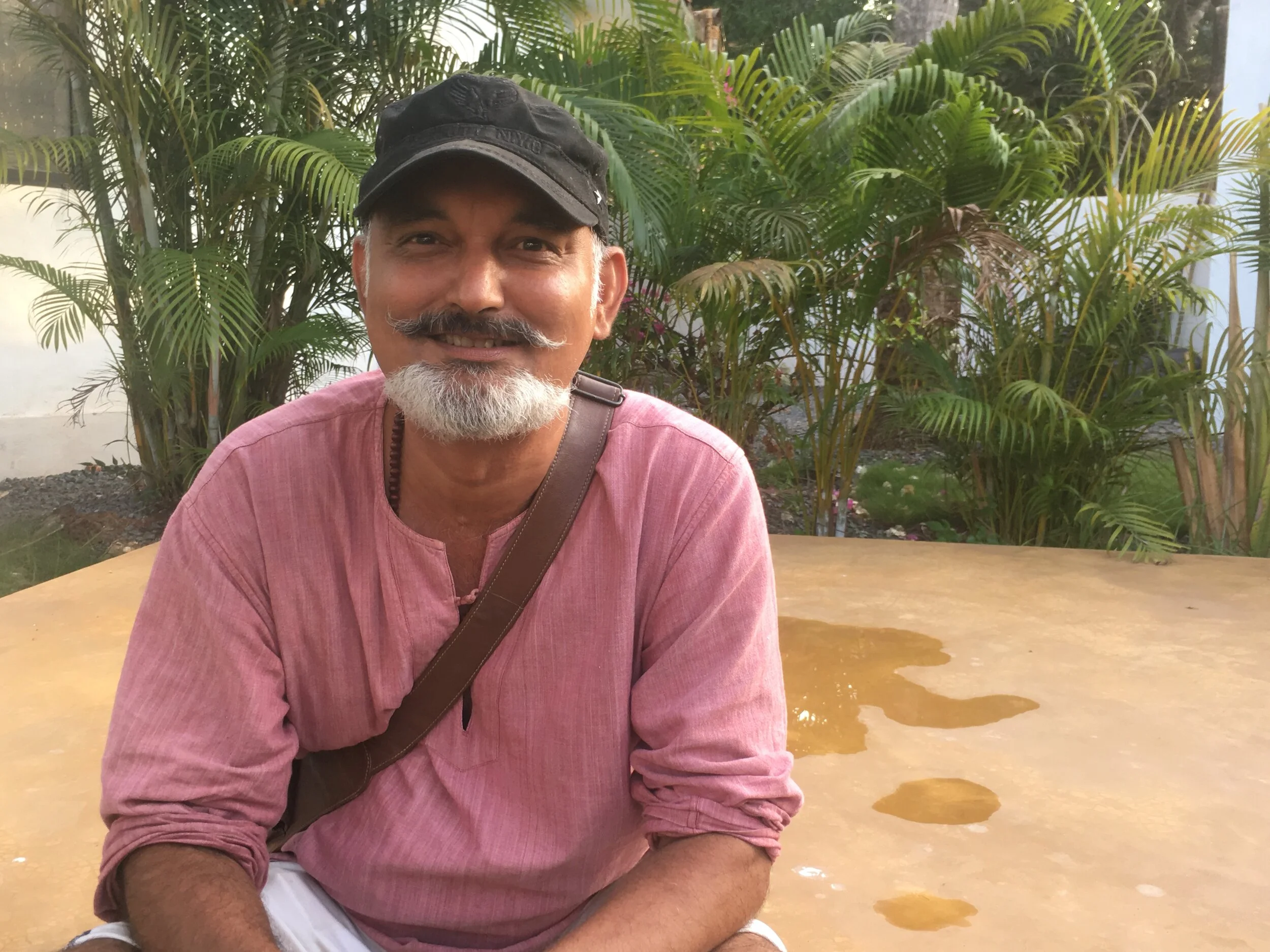 Arun BaidSupporting actor
 Meghna BhutoriaSupporting actor
 Dhwani NaiduSupporting actor
 GirishSupporting actor
 BhavyaSupporting actor
 AnnapurnaSupporting actor
 Shreshth MohanSupporting actor
 CheScript builder
 AryaaArtist: set design and installation
 NabeelaSet design support
 Cava studentsPainting the set banners
 Griffith Allan WebsterLight, sound and installation
 Ruchika NaiduCostume research and execution
 Urja and RohanCostume makers
 AryaCostume assistance
 SeemanthiniProject coordinator
 AnupamaRehearsals and care for actors
 DonnaProduction volunteer, social media
 AksharaSocial media design
 AnuroopaTeaser reel and poster
Made possible by our supporters
The play was crowdfunded. ColorAshram bore the cost of directing, rehearsals, the artworks and the costume dyeing, painting and social media. Our co-founders put in ₹35,000 between them, and the rest came from the supporters below. The Jagannatha Centre for Arts and Culture, Mysuru, was our space partner and collaborator. Many supporting actors and volunteers gave their time and energy. Thank you.
- Namrata Bhutoria
- Arun Baid
- Mohan Lal Baid
- Kamakshi Mohan
- Aditya Sondhi
- Ramanjit Kaur
- Anju Ghoriwala
- Nidhi
- Pragya Gupta
- Charu RajGarhia
- Shiree Arora
- Kalpana Sethia
- Meghna Bhutoria
- Vatsal Manot
- Purav Manot
- Manish Jajodia
- Ananta Padmanabhan
- Juliya
- Gautam
- Deborah White
- Sally Mason
- Vinita Abhani
- Yashwant
- Ruchika
- Dharam Vir
- Rakesh Rajan
- Aarti Monappa
- Harshvardhan Rai
- Zabeeni
- Paola Monaldi
- Naveen Thomas
- Ravi & Lalitha
- Bhumika